

Blog
The Science and History of N₂O in the Food Industry: From Laboratory Curiosity to Culinary Essential

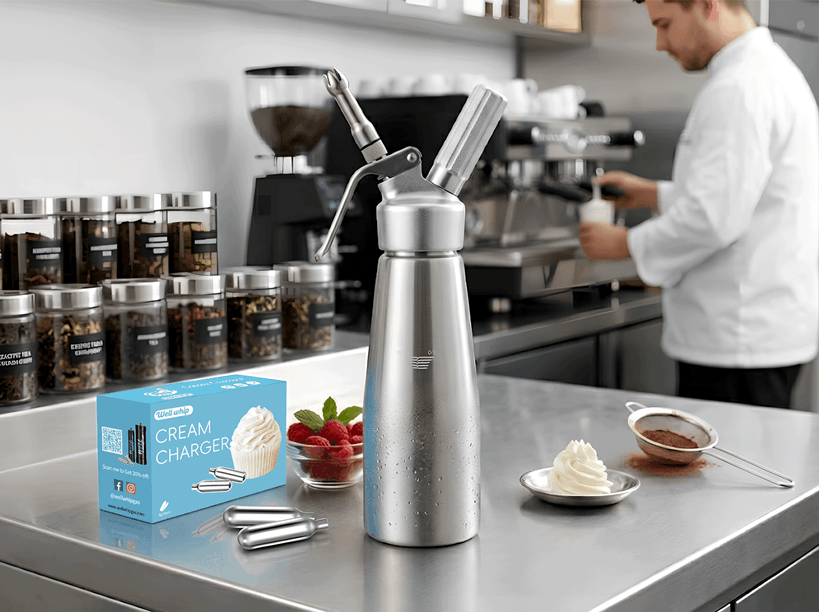
In the contemporary landscape of haute cuisine, food grade N2O is a ubiquitous yet misunderstood substance as Nitrous Oxide (N₂O). While often overshadowed by its medical applications, this colorless, non-flammable gas serves as the invisible architect behind the ethereal textures of modern gastronomy. To understand its role is to traverse a timeline of chemical innovation, from the rudimentary experiments of the Enlightenment to the precision-engineered solutions offered by industry like Wellwhip.
The Science of Food Grade N2O
The efficacy of N₂O as a culinary propellant is not a matter of chance but a result of its unique physicochemical properties. Unlike Carbon Dioxide (CO2), which imparts a carbonic acid sharpness and can curdle dairy proteins, N₂O is bacteriostatic and chemically inert in food contact, preserving the delicate organoleptic profiles of fats and sugars.
Molecular Mechanism and Solubility
At the heart of a whipped cream charger lies the principle of Henry’s Law, which dictates that the amount of dissolved gas in a liquid is proportional to its partial pressure. When N₂O is introduced into a pressurized canister containing high-fat cream (typically 30-36% lipids), it dissolves into the fat globules.
Upon triggering the discharge valve, a phenomenon known as adiabatic expansion occurs. The rapid transition from a high-pressure liquid state to an atmospheric gaseous state causes the dissolved N₂O to expand instantaneously, creating a matrix of micro-bubbles within the lipid structure. This results in a foam with a tertiary amine-like stability and a volume expansion (overrun) that far exceeds manual aeration methods.
Purity and Phase Transitions
For a gas to be classified as food-grade (E942), it must adhere to rigorous purity standards, often exceeding 99.5%. Impurities such as nitric oxide (NO) or nitrogen dioxide (NO2$) must be eliminated through sophisticated multi-stage filtration. The critical temperature of N₂O (36.4 °C) allows it to remain in a liquid state under pressure at room temperature, providing a high energy density within the compact confines of a Wellwhip premium charger.
The History: From “Laughing Gas” to Global Commercialization
The trajectory of N₂O in the food industry is a testament to human ingenuity in repurposing chemical discovery.
The Enlightenment Roots (1772–1844)
Nitrous oxide was first synthesized in 1772 by the British polymath Joseph Priestley, who termed it “dephlogisticated nitrous air.” For decades, it remained a laboratory novelty used primarily for public demonstrations of its euphoric effects. It wasn’t until the mid-19th century that its potential as a preservative and propellant began to be hypothesized by early food chemists exploring the stabilization of perishable dairy products.
The Rise of the Aerosol (1930s–1950s)
The true commercial inflection point occurred in the 1930s. Researchers at the University of Illinois, led by G. Frederick Smith, began investigating the use of N₂O to create “instant” whipped cream. This led to the development of the first commercial aerosol cream cans. By the 1950s, the technology had matured, transitioning from heavy, refillable tanks to the standardized, single-use canisters that paved the way for the modern whipped cream charger science we recognize today.
Modern Applications: Engineering the Future of Flavor
Today, the application of food-grade N₂O has moved beyond simple whipped cream. In the realm of molecular gastronomy, N₂O is the primary agent for “rapid infusion”—a process where high pressure forces liquids (like spirits or oils) into the cellular structure of solid ingredients (like herbs or fruits), achieving in minutes what traditionally took weeks.
Global Standards and Quality Control
The modern industry is governed by a complex web of European food standards and US food-grade gas regulations. Compliance with HACCP (Hazard Analysis and Critical Control Points) and ISO 22000 is no longer optional but a baseline for entry. Wellwhip distinguishes itself by utilizing aerospace-grade aluminum and specialized internal cleaning processes that ensure the gas remains free of the industrial oils and metallic micro-particulates often found in lower-tier alternatives.
| Feature | Standard N₂O Charger | Wellwhip Premium Technology |
| Purity Level | 99.1% – 99.5% | >99.7% (Ultra-Pure) |
| Internal Coating | None | Anti-Oxidant Protective Layer |
| Pressure Stability | Variable | Precision-Engineered (±2% variance) |
| Environmental Impact | High Waste | 100% Recyclable Materials |
Safety, Sustainability, and the Wellwhip Promise
As the culinary world moves toward a more sustainable future, the focus has shifted toward intelligent gas technology and minimizing the carbon footprint of distribution. Safety remains the paramount concern; the transition from carbon steel to lighter, more durable alloys in Wellwhip’s design reduces the risk of structural failure under extreme thermal stress.
Furthermore, the industry is seeing a shift toward larger-format cylinders for high-volume B2B environments. These systems offer precision pressure control, reducing gas wastage and ensuring a consistent texture across thousands of servings—a critical factor for franchise consistency in the global coffee and confectionery sectors.
Conclusion: The Invisible Ingredient
The story of N₂O is far from over. As we look toward the next decade, innovations in sustainable packaging and even higher purity thresholds will continue to refine the way we experience texture and flavor. Wellwhip remains at the vanguard of this evolution, committed to providing the professional community with the tools necessary to push the boundaries of culinary science.