

Blog
Safe and Efficient Use of 640g Whipped Cream Chargers in Commercial Kitchens


Look, I’m gonna be straight with you. When I first started managing a kitchen, nobody sat me down and explained how to handle those larger nitrous oxide tanks. They just showed up on a delivery pallet, someone said screw this thing into that thing, and off we went. It wasn’t until years later, after a few close calls and one genuinely terrifying hissing incident that cleared out half the prep kitchen, that I realized how stupid that was.
Pressurized gas in a busy commercial kitchen is no joke. It’s also not something to be scared of, it’s something to understand. And once you understand the right way to handle 640g whipped cream chargers, they become one of the most reliable, time-saving tools in your entire operation.
Why You’re Probably Already Using the Wrong Size
Let me guess. You’re still buying boxes of those little 8g cartridges, aren’t you? I did that for years. Every few days, another box. Every shift, someone is digging through a drawer for another tiny cylinder. It felt normal because it’s what we’d always done.
Then someone smarter than me did the math. One 640g N₂O tank replaces about 80 of those little guys. Eighty. That’s not a small difference; that’s a complete workflow shift.
Think about what that actually means on a busy Saturday. Instead of 80 interruptions each one a moment of fumbling, unscrewing, reloading you’ve got one connection that lasts through multiple batches. Your pastry station stops being a pit stop and starts being a proper production line. The time-saving alone pays for the upgrade within weeks.
The Safety Stuff Nobody Talks About (But Should)
Okay, here’s the part that usually gets skipped in the product descriptions. These tanks are safe, really safe when handled correctly. But correctly requires some basic knowledge that most kitchens never bother to teach.
Storage isn’t just put somewhere.
Those tanks need a cool, dry spot away from heat. Not near the ovens. Not in direct sunlight by the window. Heat builds pressure, and pressure you didn’t account for is pressure that can cause problems. Also, they need to be stored upright and secured so they don’t get knocked over. A falling tank can damage the valve, and a damaged valve is where leaks start.
The connection trick that saves your sanity.
When you attach a 640g charger to your dispenser or regulator, hand-tight is perfect. I cannot stress this enough. I’ve watched guys grab a wrench and crank down like they’re changing a tire, and all it does is crush the seal. Then gas leaks, cream doesn’t whip, and everyone blames the equipment when it was really the gorilla grip. Snug by hand. That’s it.
The hiss test.
You know that sound when you first break the seal? A quick pass is normal, that’s gas entering the system. What’s not normal is a continuous hiss. If it keeps going, something’s wrong. Maybe the seal is damaged, maybe the tank is faulty, maybe you cross-threaded it. Whatever the reason, shut it down. Disconnect carefully. Set that tank aside. Don’t try to fix it yourself during a rush.

How to Actually Use These Things Without Drama
Here’s the simple routine that keeps things moving and keeps everyone safe.
Step one: Check your gear.
Before you connect anything, look at the tank. Any dents? Rust? Damage to the top where the valve is? If it looks beat up, don’t use it. That tank goes in the return to the supplier pile, not in your dispenser.
Step two: Connect with confidence.
Line it up, screw it on by hand until it’s snug. Give it a tiny extra turn to be sure, but stop before you feel resistance. If it’s tight and not leaking, you’re golden.
Step three: Shake like you mean it.
Once the gas is in, your dispenser needs a few good shakes. Not gentle little wiggles actually shakes that slosh the cream around. That’s how the nitrous oxide distributes evenly. Skip this step and you’ll get uneven texture, with some servings perfect and others weak.
Step four: The cold cream rule.
This isn’t optional. Use cream straight from the fridge, the colder the better. Cold cream absorbs gas more effectively and gives you that smooth, creamy texture that holds its shape for hours. Room-temperature cream turns into a soupy mess no matter how good your charger is.
Step five: Store smart.
When the tank is empty or you’re done for the shift, disconnect it. Store empties separate from full ones. Nothing kills efficiency faster than grabbing what you think is a full tank during a rush only to find out it’s already been used.
Why Cafés and Bakeries Love the 640g Size
Here’s the thing about the 640g whipped cream charger: it’s the Goldilocks size for most commercial kitchens. Not too big, not too small.
Small cafés running on 8g cartridges waste so much time on changes it’s almost criminal. Big operations jumping straight to 3.3L tanks sometimes find them bulky to store and handle. The 640g sits right in the middle big enough to save you from constant cartridge changes, small enough to fit in a standard storage shelf.
Plus, with that 5 year shelf life, you can buy in bulk during a sale and not stress about them going bad. The leak-proof design means you’re not losing gas to the atmosphere, and the high-purity N₂O means your cream tastes like cream, not like metal or chemicals.
I’ve seen bakeries switch to these and immediately notice two things: their whipped cream holds better on display cakes, and their staff stops complaining about the constant cartridge changes. That second one matters more than you’d think.
A Quick Word on What Not to Do
I feel like I should mention this because I’ve seen it attempted. These tanks are for culinary use only. Not inhaling. Not refilling. Not modifying. The high grade stainless steel is built to hold pressure safely, but only if you use it the way it was designed.
Also, keep them away from kids. I know that sounds obvious, but in a home-based bakery situation where kids might be around, treat these like you would any other dangerous kitchen tool locked up and out of reach.
The Bottom Line for Your Kitchen
At the end of the day, switching to 640g N₂O tanks is one of those upgrades that feels small on paper but changes everything in practice. You save time. You save money. You get better, more consistent cream. And when you follow the basic safety steps, you do it all without drama or danger.
The best part? Once your team learns the routine, it becomes automatic. They’ll stop thinking about the tanks entirely and just focus on making beautiful desserts. That’s the sign of a tool that’s doing its job right.
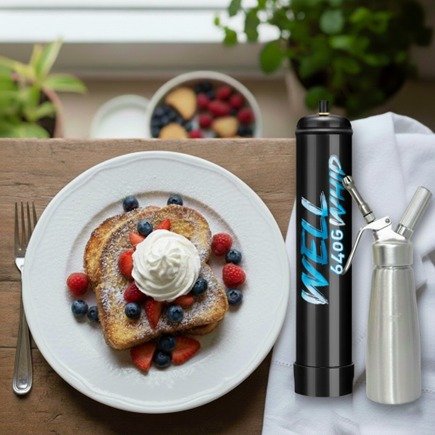
Ready to make the switch and see what real efficiency looks like? The WellWhip 640g charger is built exactly for kitchens like yours busy, professional, and tired of messing with tiny cartridges. Give it a shot. Your pastry station will thank you.